Saturday, 21 July 2012

DELICIOUS DIJON

This morning, after a great night's sleep and the promise of a very fine day, we rose early (for us) and walked to Les Halles - a beautiful, ornate, metal and glass marketplace built by Gustave Eiffel in about 1832.


Both loving food and cooking, we spent ages browsing and dreaming of what we could produce if we had such fantastic ingredients so easily available in Singleton!


Inside the market


Bresse Chickens, reputedly the very best in the world, identified by their blue feet.


Horse butcher - why is it yukkier than eating beef? Look carefully at the top left-hand side, and you'll see the horse.


A very small selection of the terrines, all fabulous in presentation.


These mushrooms, girolles, are in season now and feature on many menus.


There is also an enormous variety of fruit and vegetables, cheese especially from here, but also from other parts of France. We wonder why we won't allow cheese to be imported into Australia unless it's made from pasteurised milk - pasteurising removes a lot of the flavour. So many really great cheeses are made from unpasteurised milk.


Really, I couldn't name all the food related products for sale. Even jambon Iberico was available for a snip at 100 euros a kilo!


Slightly off-putting is the French way of displaying any poultry still with it's head and feet on, often split to show the offal is intact. The French love their food and are very serious about how it should be displayed. They also eat every bit of any annimal, careful when ordering you're not getting, as one waitress mimed to me, "the man bits"!


Bon appetite!

Friday, 20 July 2012

DAMBACH TO DIJON

We had hoped to leave some dull and damp weather behind but alas it followed us down the Rhine valley. We said good bye to Dambach and paid our last respects to the vineyards and villages that lined the valley walls as we headed south.

Sunset last night in Dambach, hopes of better weather tomorrow

Au revoir Dambach

A longish but lovely drive later we navigated or way through the suburbs of Dijon to our hotel in the middle of town. We have been so lucky with our hotel situations, not without a lot of planning on Anne's behalf. A brief walk around town, the obligatory visit to the Cathedral, and a quick check out of potential dining spots. 

An oldie, built in 1220 and still going strong!

Mustard anyone?

A big choice of Maille mustards


Thursday, 19 July 2012

AU REVOIR ALSACE


We planned a long relaxing stay in these parts, and so it has been. We’ve travelled the length and breadth pretty much including two sorties into Germany. Today started a little damp but improved as we drove south. Through Colmar and Guebwiller and many other …willers, but no Rottweilers!! Pretty country latticed with vineyards and amazing little single church towns, two, three or four “Fleurie” villages just within earshot of each other.

Guebwiller

Lunch in Germany and another two crossings of the Rhine including one that was also a part of a gigantic lock. We stopped and marvelled at the engineering that allows the large barges to rise and fall with such apparent ease.

Going down ...

... and down and out!

Off south tomorrow, to Dijon for a taste of something different!

A GERMAN GEM


Further to exploring the Alsace region, this morning we headed for Strasbourg at it’s Northern tip. Through some of the smaller villages along the “Route de Vin” we were in Strasbourg in short time. Still in France, just, it reminded us of Paris, wide boulevards, a meandering river through the centre and beautiful buildings throughout.


We headed for the Cathedral, the tallest spire in Europe, until the 19th century, showing us the way. It was an amazing Cathedral, one of the most beautiful we have seen with fabulous stained glass windows throughout. An amazing astronomical clock was an unusual feature.

Cathedral square

Astronomical clock

One of the oldest building in town.

We then headed out of town, picnic in hand, over the Rhine and had lunch by the river in Germany! (We thought of you Kristin! Wished you could have interpreted the road signs for us!)

Not a great shot, but it is the mighty Rhine

Back in Dambach, we went on a “Cellar Tour” with a local grower/winemaker – a young fellow, who is making fantastic organic wines – needless to say, we have a few to sample later! He spoke good English and we had the opportunity to compare growing and wine making traditions. He was the 15th generation of Becks who had made wine in the village.

Winemaker Florian Beck

He recommended a small restaurant two villages away. Mainly locals it was a great meal of traditional Alsatian cooking.

Lamb shank and Alsatian casserole


Tuesday, 17 July 2012

MARCHE (MARKETS) MANIA


It seems we have struck the Alsace at Market time. There’s one on in every village and town nearby on different days. Last night we had a ‘partisan market’ in Dambach. Not very large but interesting never the less. Plenty of meats, bread and cheese of every type, including a local favourite, Munster. There were wine tastings too. We purchased a pack of Pinot Gris and Gewurztraminer from the local vigneron, as well as a large slice of yummy myrtle pie.


There was a pizza dinner and ‘oompah’ music provided by the local band. We skipped the pizza and settled for a local restaurant. A brief stop for a glass of local wine along the way at a small and very friendly bar. (In fact we can’t quite believe the friendliness from the Froggies in these parts, there’s always a ‘bon jour’, ‘bon soir’ or ‘aurevoir’ from passers by.)

Our wine, but my self photography needs some better aim!

Today we headed for the next quick “marche’ in Selestat. A much larger town about 15mins away. A much bigger market too – a lot of fashion (if you can call it that!) but also a stack of food. We are starved of fresh greens with meals in most restaurants, so it was green envy! Some nice fresh fruit was purchased – bananas and apricots, as well as some bread, tomato and some tasty terrine for a picnic lunch.

Markets with St George Cathedral in background

A few smaller towns on the ‘Vin route’ and we turned for home at Riguewihr, a stunningly beautiful fortified town built in the 13th century. It is listed as one of the “Most beautiful Villages in France” and was consequently packed with tourists – a little unusual in these parts.

Riguewihr, just stunningly beautiful


Another diversion along the way was the Chateau du Haut-Koenigsbourg. It was built at the top of a 750 metre peak, Stophanberch mountain, looking down the ‘Plaine d’Alsace’ in the 12th century. It had been conquered but abandoned by the Swiss for several centuries but was restored by the German Emperor “Kaiser’ William II as a Middle Age museum from 1900 to 1908. This part of (now) France has changed hands between Germany and France a number of times and although William’s restoration was immense and personal it, (and the Alsace), has since returned to French control after the Treaty of Versailles (1919).

Chateau du Haut-Koenigsbourg

William II's dining room roof decoration, hardly subtle!

View of the valley from the chateau.

Monday, 16 July 2012

DIVINE DAMBACH-LA-VILLE


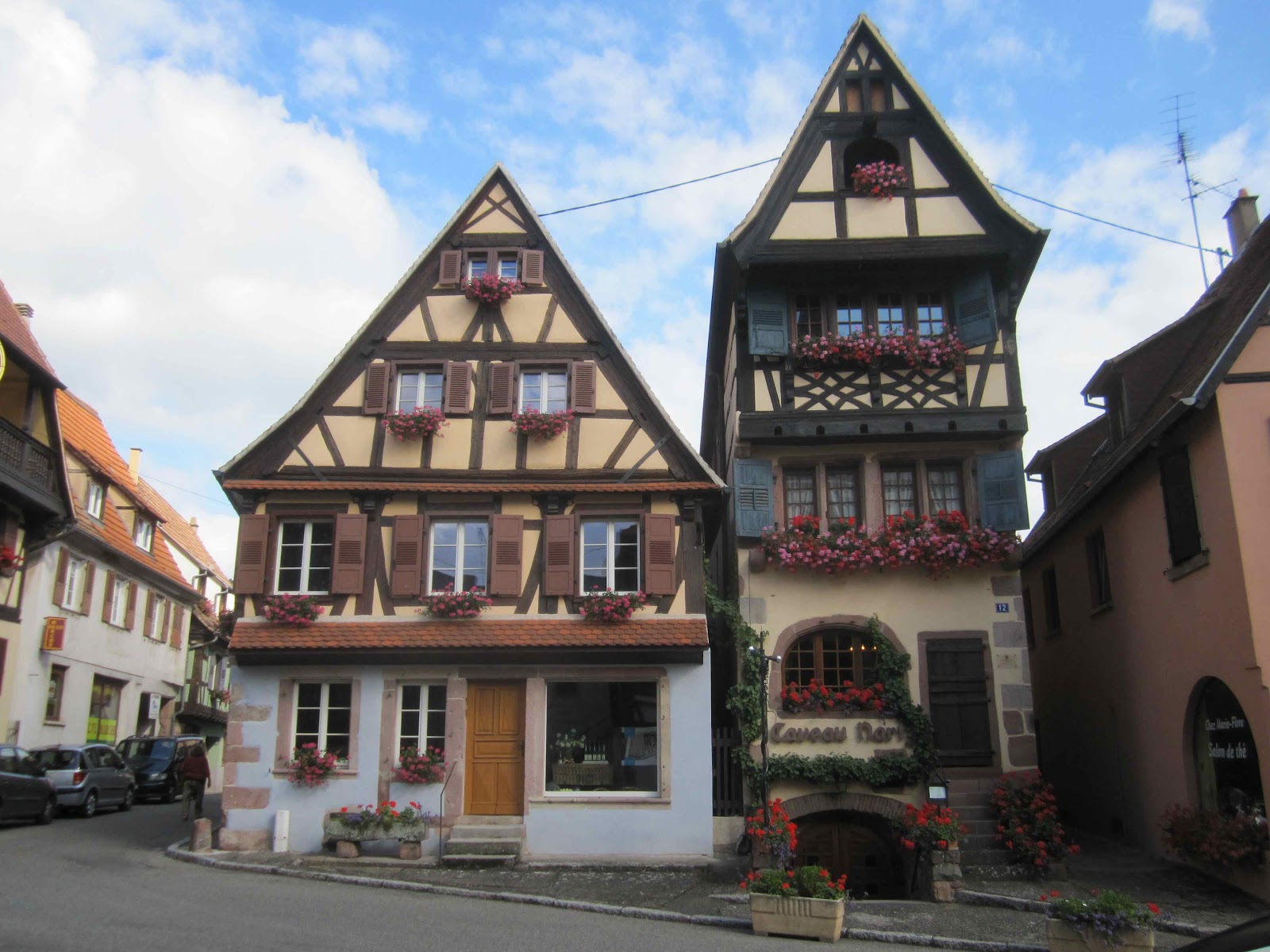
We really feel we’re in an amazing Tyrolean village! The buildings within the walls of this medieval town are amazing. They represent a number of different historical periods, half-timbered houses of the Middle Ages, stone edifices of the Renaissance (Peasant War) and 17th century homes rebuilt after the Thirty Years War as well as numerous large cellars representing the flourishing wine trade of the 18th century.

The narrow building on the right reveals the shortage 
of space within the city at the time.

Old and beautiful

Dambach was a consolidation of smaller villages in the area and became a fortified Episcopal city in the 14th century by the Bishop of Strasbourg to help protect the inhabitants. 

The city gates were built in 1323.

We had a lovely meal last night, despite some language difficulties we managed to order two great dishes, one a slow cooked pork shin, the other a loaf of mixed meats – sounds funny but tasted great. But the best part of all was the local Grand Cru Riesling – quite a treat!

A great local Grand Cru Riesling

This morning we had a two hour walk up quite a steep mountain behind the village to the ruins of Bernstein Castle, a 12th century granite palace with rare Romanesque windows. It was conquered in 1277 by the Bishop of Strasbourg who already occupied the city.


The Saint Sebastian Chapel, on the way, is the former parish church of an abandoned village just above Dambach. The altar is quite unusual and was carved in 1690 from linden and pear woods.


The city is surrounded by over 450ha of vineyards, 45 of which are ‘Grand Cru Frankstein’ and there are a number of cellars around town still operating today as they have done for centuries.

Ripening Riesling

Who said it doesn’t get cold in winter!